-
Knowing My Rights
Like one in three people in the UK, I am a renter.
And like them, the main reason for this is that I don’t happen to have £435,000 (over half a mill in USD) stuffed in my back pocket. Unlike them, however, homeownership would mean an exponentially more complex (and expensive) US tax return, which I am required to file (and pay) every year, along with a list of all my assets. So you see, unless (until 😉) I make it into the millionaire class, owning a home is not in the cards.
Therefore, I rent, and therefore I have no rights.
A major difference between the US and UK that rather surprised me when I first came over is that Realtors (in the UK, we call them Estate Agents) do not need a license. Any yokel can simply hang out a shingle and call themself an Estate Agent and immediately begin shafting tenants.
We started out with a company called Leaders, who were no better or worse than anyone else, and for a while things ran as I would expect: we paid our rent, they renewed our lease once a year, and then we paid our rent, plus a bit more. Then one year, they also charged me a fee. When I queried it, they told me it was an admin fee to cover the lease renewal. That sounded like a load of bollocks to me, but they had the upper hand, so I, therefore, paid the fee.
This, however, gave them (and all Estate Agents) the impetus to expand, and soon “Because We Can” fees included drafting letters, taking complaints, dealing with disputes, and there was nothing we could do about it because renters have no rights.
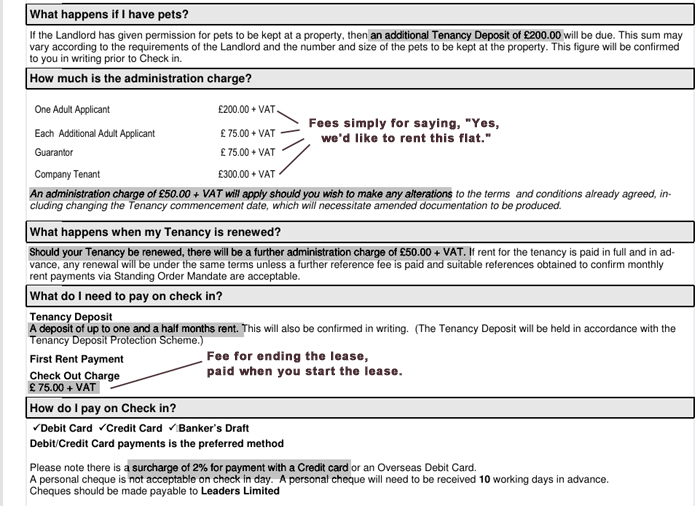
All these “Because We Can” fees need to be paid before you even sign the lease I knew a bit about renting in the US—having, during four tumultuous years, moved seven times—and I never felt as insecure as I have renting in the UK. Here, for example, landlords can demand whatever security deposit they wish, openly discriminate, raise your rent at any time to anything they please, and throw you out for any, or no, reason any time they wish (the infamous “Section 21” eviction).
This, of course, gives rise to people living in squalid conditions because, if they complain, they could be out on the street.

My new flat Hope, however, is in sight. The Renter’s Rights Act—after being kicked around for a decade or more—has finally been signed into law. In addition to ending the Section 21 evictions, it also proscribes “Because We Can” fees, discrimination, and onerous rent hikes. It also limits security deposits to a single month’s rent, stops landlords from retroactively raising rents, disallows “revenge evictions” (i.e. the tenant reports that the roof leaks) and provides stronger enforcement powers.
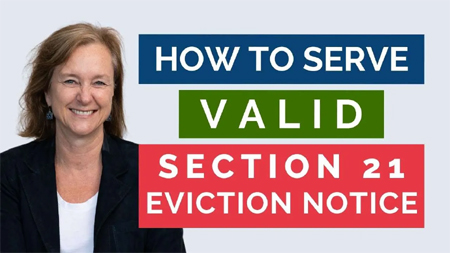
A real ad; landlords gleefully sharing tips on how to unhouse people As you might imagine, I have been following this bill on its slow march through the legislative process and celebrated its passing. However, it is not coming into force until the 1st of May 2026, giving landlords plenty of time to evict, retroactively raise rents, or—as many are doing—sell up and move on, leaving the erstwhile tenants, literally, out in the cold.
Our journey as renters has been comparatively peaceful. We have been fortunate to be able to pay our rent on time, handle the random fees foist upon us, and live quietly enough so that our landlord doesn’t notice anything other than the money rolling in. Even so, we have always had, in the forefront of our minds, the nagging reality that, at any time, we could find a letter on our doormat demanding we leave, and we would have no option other than to comply.
The Renters’ Rights Act has, therefore, been a welcomed upgrade to our lives, but we still need to get through the next five months.
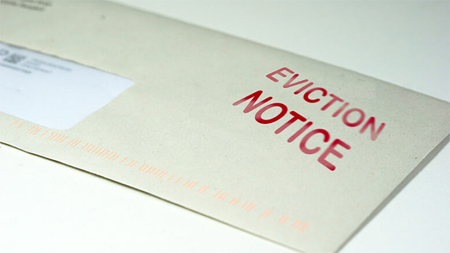
Hoping I don’t see one of these in the near future I know nothing about the buying and selling of flats in the UK, but I am hoping the process takes a long time; it would be nice to think that the deadline for selling up and turfing us out has passed.
Until then, however, I am ticking off the days, crossing my fingers, and keeping an eye on the rental market.