-
It’s All About the Story
Today I went to the Cuckfield Bookfest, and it confirmed for me something that I have been thinking about for the past few months. But first, the Bookfest.

Cuckfield Bookfest We went to see Lucy Mangan in a Q&A with Ana McLaughlin. Lucy is an author, columnist, features writer and TV critic for The Guardian, and an opinion writer for i news. Ana McLaughlin doesn’t seem to have a Wikipedia page that I can copy. However, someone with a similar name is a former member of the US Army Special Forces and current MMA fighter. I don’t think that’s her, though.
While Lucy has written a straight-up novel, she mainly writes humorous non-fiction, and most recently has written about reading—first in Bookworm, and more recently in Bookish, the new release her publishers sent her there to pimp.
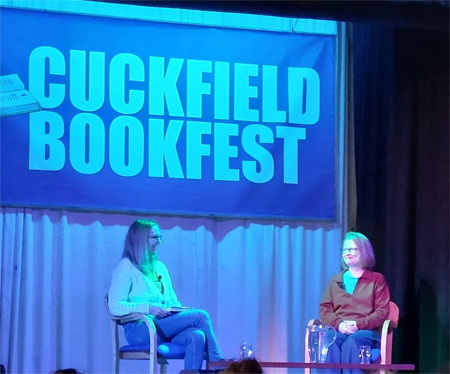
Ana and Lucy During her entertaining back-and-forth with Ana the Cage Fighter (actually, I think she’s an author and a book publicist), Lucy mentioned a popular Facebook mime about reading that goes something like this: reading is the act of staring at slices of processed wood pulp covered in black squiggles while fantasising vividly for hours on end.
That is certainly apt: the black marks the writer makes—the letters, the words, placed in a particular order—sets the reader’s mind free, opening an imaginary world that only they can see. It’s akin to magic, this thing that the writer does for the reader. But what about the inverse? The act of the reader reading the words that give their imagination flight makes those words come alive. In other words, without a reader, there is no story.
And this is what I have been grappling with.
During that long decade I spent working on The Talisman series, I mentioned several times that I didn’t care if I got them published (good thing, because I couldn’t) or if anyone read them, because I just wanted to finish them for the simple satisfaction of having done it. That turns out to not be the case.
I did what marketing I could: the local library (don’t call us, we’ll call you), the local bookstore (thanks, but no thanks), a local book store that specialises in local authors who self-publish books (never heard back from them even though I wrote twice), a column in the local paper (I had to beg for it), a column in a local magazine (ditto), and a local shop that, among other things, features local authors (Yay! They took them and had me do a signing: two friends stopped to say, “hi,” my wife came by with a cup of coffee, and I didn’t sell a single book).
And that’s sorta been how it continues.
Since official publication (this does not count the books I sent to my two beta readers because they didn’t actually buy them) the series, in total, has sold six books: two from each of the first three in the series. Books Four, Five, Six, Seven and Eight have sold a total of zero. This is something of a disappointment, especially seeing as how I’ve sold 10,000 of the Postcards books and almost 2,000 of Finding Rachel Davenport.
It also, strangely, made me want to read them myself.
This is not something writers do, and I am no different. By the time you finish a book, you are sick to death of it. The editing, the revisions, the proof reading, the formatting; by the time that’s all done, the last thing you want to do is read the fucking thing. Also, there is the fear you will find it lacking, that the passage of time will allow you to see the glaring faults, dead prose, and errors. But, as the weeks went by, the urge became stronger, and one day I gave in and, with trepidation, picked up Book One: The Magic Cloak.
I was, honest and truly, captivated.
So much time had passed, and the manuscript had gone through so many edits and revisions and travelled down so many dead ends and cul-de-sacs that I genuinely had no idea where the story was going. It was well-written, fast-paced, and I found myself eager to get back to it. And as a bonus, it was nearly error-free.
When I finished Book One, I went on to Book Two, and Three. I am currently on Book Six and, over the previous volumes, have been genuinely surprised by the plots. Scenes I thought I had written were not there, and scenes I could not recall writing were, and the books were better for it. The only regret I have is that there are only two more books to go.
None of this, of course, addresses the main issue—the story lives only in my mind, and no one else’s, giving rise to the question, if a story has never come alive in the mind of a reader, does it exist?
Maybe I can intrigue the Cuckfield Bookfest people with that topic and win a place on a discussion panel next year. That might shift a few copies.
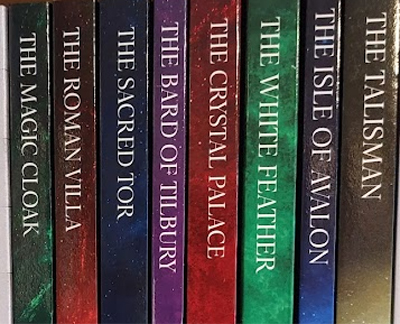
Schrodinger’s Book Series: it exists, yet it doesn’t Stranger things have happened.